Category: Yoga Therapy

Yoga therapy uses movement and breath work to deepen your body connection. Here you can discover what it is to process mentally and emotionally in this embodied state.

  • Yoga Therapy and The Chakras

    Yoga Therapy and The Chakras

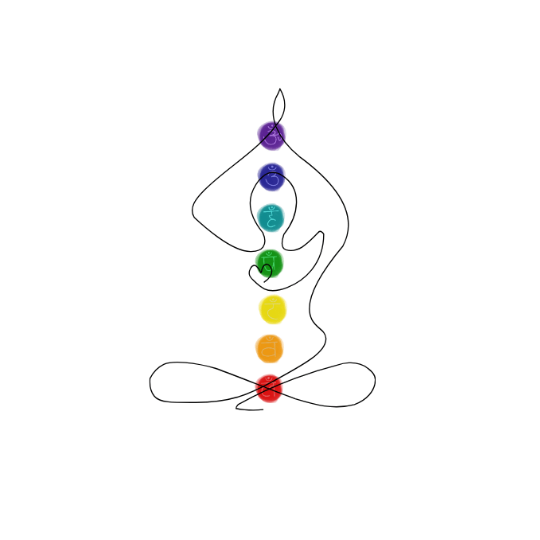
    The chakras are believed to be energy centers in your body that can affect your physical, emotional and spiritual wellbeing. Yoga therapy is a way to connect deeply with yourself, your body and your chakra energy.

    “Chakra” in Sanskrit means wheel or cycle

    My yoga therapy practice is body based. That means you use your body to connect deeply with your self. The sensations you notice in your body while you are deeply settled in a yoga pose are used to draw you deeper into yourself and to connect deeply with your self. In this embodied state you start to notice feelings, emotions, thoughts or memories. This gives you a whole new insight into yourself and your life. An insight into what might be holding you back from achieving your goals, what is truly making you sad, why you feel so stuck or dissatisfied. If we use our body rather than relying on our mind (our story), we have a new way figure out what is going on. 

    How do the chakras relate to yoga therapy?

    As a Phoenix Rising (PRYT) yoga therapist, I like to incorporate the themes of

    • embodiment,
    • awareness,
    • acceptance,
    • choice,
    • discernment,
    • truth,
    • truth in action, and
    • flow

    into my sessions. These work particularly well in group sessions as a series to build upon.

    As you can see below the PRYT yoga therapy themes tie in pretty well to the chakras.

    Yoga chakras and how they relate to you

    Root Chakra

    I am safe

    Root chakra is the first step on the journey of personal development and relates to embodiment and befriending your body.

    Sacral Chakra

    I am creative

    Sacral chakra is the dwelling place of your self and relates to self-awareness.

    Solar Plexus Chakra

    I am strong

    Solar plexus chakra is the center of your personal power. This chakra govern identity, as well as personal freedom, choice, and authenticity. Self-love, self-acceptance, and acknowledgment of your worth are related to this chakra.

    Heart Chakra

    I am loved

    The heart chakra is associated with unconditional love, compassion, and joy. It is the source of profound truths that cannot be expressed in words.

    Throat Chakra

    I am truthful

    The throat chakra is concerned with your ability to speak your truth and is therefore truth in action.

    Third Eye Chakra

    I am insightful

    The third eye is the chakra of your intuition. Discernment comes from a balance of intellectual reasoning combined with your intuition and gut instincts. Discernment is your ability to perceive what is true.

    Crown Chakra

    I am divine

    On an emotional level, the crown chakra generates devotion, inspirational and prophetic thought, mystical connections, and transcendental ideas. Opening of the crown chakra brings bliss and therefore relates to flow.

    Yoga therapy, the chakras and self care

    Although in my sessions I don’t prescribe yoga poses for blocked or imbalanced chakras I do like to draw on yogic philosophy and teachings. Here is a fun list of 7 self-care ideas related to your chakras for you try. Start at the root and do one each weekend.

    Chakras and self-cares fun way a list of 7

    Book a yoga therapy session

  • What is Yoga Therapy?

    What is Yoga Therapy?

    Yoga therapy is a yoga modality that is more therapeutic in its intention than say a yoga class. Like a yoga class which has different styles. For example Hatha, Vinyasa and Ashtanga for example. Yoga therapy has different styles. So it’s worth doing your research to check if your practitioner will be good fit to help you meet your needs and achieve your goals.

    Our governing body says

    Yoga therapy is the process of empowering individuals to progress toward improved health and well-being through the application of the teachings and practices of Yoga.

    International Association of Yoga Therapists (IAYT)

    I believe a yoga therapy session should be a safe space to explore your physical, mental, and emotional limits. It’s an opportunity to connect with your body, gain insights into yourself, and achieve a deeper understanding of that self.

    My teacher describes the style of yoga therapy I practice as

    Combining breathwork, gentle poses, meditation, and guided self-inquiry, designed to help practitioners safely embrace their physical limits in order to gain mental and emotional insights into themselves. It does not replace psychotherapy (talk therapy), but rather provides a somatic pathway to a deeper understanding of the self.

    Michael Lee, Phoenix Rising Yoga Therapy

    What does a session with Pure Yoga Therapy session look like?

    Because I trained with Phoenix Rising Yoga Therapy (PRYT),I like to stay true to their somatic approach. Each session starts with a warm-up to connect your body and your breath. And to prepare your bodyfor the simple yoga poses that follow. I like to use props, so you can feel support you in the poses. As this allows you to ”drop-in”, or become embodied more easily. Most poses are lying on your mat, rather than the standing poses you might do in a class. This is because these restful poses also make it easier for you to “drop-in”. The session ends with a short meditation, and an opportunity to reflect on any insights you might have gained during the practice.

    Throughout your session, you explore “the edge,” which is the feeling of sensation when you are in a pose. This sensory awareness allows you to focus and connect more deeply with your body. In this embodied state you become more aware of your body, your feelings, and your emotions.

    The 6 Phases in a Phoenix Rising Yoga Therapy (PRYT) Session

    1. Warm-Up 

    The warm-up is all about connecting your body and your breath. It’s like a little dance that gets you ready for the poses that come next. 

    2. Edge Coaching

    When you experience sensation, such as during a yoga pose, being present in that moment can help you focus and connect with your body. The feeling of sensation is called “the edge”. Here you can feel the sensation in your body. But you are not being overwhelmed with discomfort and can remain present.

    3. Dropping In

    “Dropping in” is a state where you feel a deep connection with your body. Your thoughts slow down and you become very aware of the sensations and the emotions arising in you. In this embodied state, you can observe these sensations and emotions. Without the need to explain or attach any meaning to them. You are guided to embrace whatever you notice in your body. This state is achieved using simple supported poses, usually lying on a mat. Poses like supine twist, supported forward fold and child’s pose. 

    4. Meditation

    Reaching a meditative state is easier after body-breath work. The mind is quietened and can be centered. So, during your meditation, you can tune in to your body and your breath.

    5. Listen to your body

    When you can connect deeply to your body you notice thoughts, feelings, and maybe even images arising. This can provide new insight.

    6. Insight to action

    At the end of the session, you will explore some ways in which you can effectively integrate these valuable insights into your life. Talking about what holds you back from achieving your goals and discuss actionable steps you can take to move forward.

    What Can Yoga Therapy Do for You?

    • Allows you to reconnect with yourself

    By combining modern psychology and mindfulness techniques, yoga therapy can help you connect deeply your body in a new and profound way.

    • Helps you to navigate change

    Yoga therapy, can help you gain clarity. You can discover what might be holding you back from living your best life. You can learn how to navigate change and stop feeling like you are stuck.

    • Let’s you live a life more fulfilled

    By investing in yourself and practicing self-care, you can befriend your body and discover what it might look like to be your best self. When you know and understand yourself, you can find the path that allows you to flourish and thrive. 

    • Works with you to let transformation happen

    Stress and trauma can hold you back. Using the embodied approach you can better understand how to achieve your goals and ultimately transform to be your best self.